


Scrap.io sits close to the buyer's actual job: finding local businesses with useful contact data. Its multi-map coverage and lead filters are attractive. The alternatives below vary by where they are stronger: Google Maps-only exports, cloud scraping, business data APIs, enrichment, automation, or official place data.
This guide compares seven popular Scrap.io alternatives for Google Maps scraping, local lead generation, and adjacent data workflows. G Maps Scraper is ranked first because it is the most direct option when the core job is extracting businesses from Google Maps into a usable file.
Some alternatives are focused local lead tools. Some are APIs. Some are broader scraping or sales automation platforms. The right choice depends on whether you want a finished spreadsheet, a developer API, a broader enrichment workflow, or enterprise-grade infrastructure.
Quick Comparison
| Tool | Best For | Starting Price | Workflow | Google Maps Focus | Best Scrap.io Replacement Case |
|---|---|---|---|---|---|
| G Maps Scraper | No-code Google Maps lead extraction | Free / $39/mo | Chrome and Edge extension | Dedicated | Fast exports with phones, websites, emails, reviews, and social profiles |
| Outscraper | Managed Google Maps scraping at volume | First 500 free, then pay per record | Cloud dashboard and API | Dedicated | Cloud Google Maps scraping with API access |
| DataForSEO | SEO and business data APIs | $50 minimum payment | API | Business data focused | Local SEO, reviews, rankings, and business data APIs |
| Hunter | Email finding and verification | Free / $49/mo | Email finder and verifier | Adjacent | Email finding and verification from domains |
| Clay | GTM enrichment and workflow orchestration | Free / Launch from $185/mo | Enrichment workspace | Adjacent | Waterfall enrichment and GTM orchestration |
| PhantomBuster | Sales automation and lead workflows | 14-day free trial / paid plans | Automation templates | Adjacent | Multi-channel sales automation around scraped leads |
| Google Places API | Official Google place data integration | Usage based with monthly free caps | Official API | Official | Official Google place-data integration |
How We Chose These Scrap.io Alternatives
For Scrap.io alternatives, I intentionally included more sales and enrichment products because local lead generation does not end when the scraper finishes. The best workflow often combines extraction, qualification, and outreach.
The criteria were:
- Clear relevance to Google Maps scraping, local business data, lead generation, or the next step after a lead list.
- Enough market visibility to be worth evaluating.
- Public product pages, docs, or pricing pages that make the workflow understandable.
- A real reason to choose the product over Scrap.io: simpler exports, better Google Maps focus, API-first access, broader automation, stronger enrichment, or enterprise infrastructure.
1. G Maps Scraper
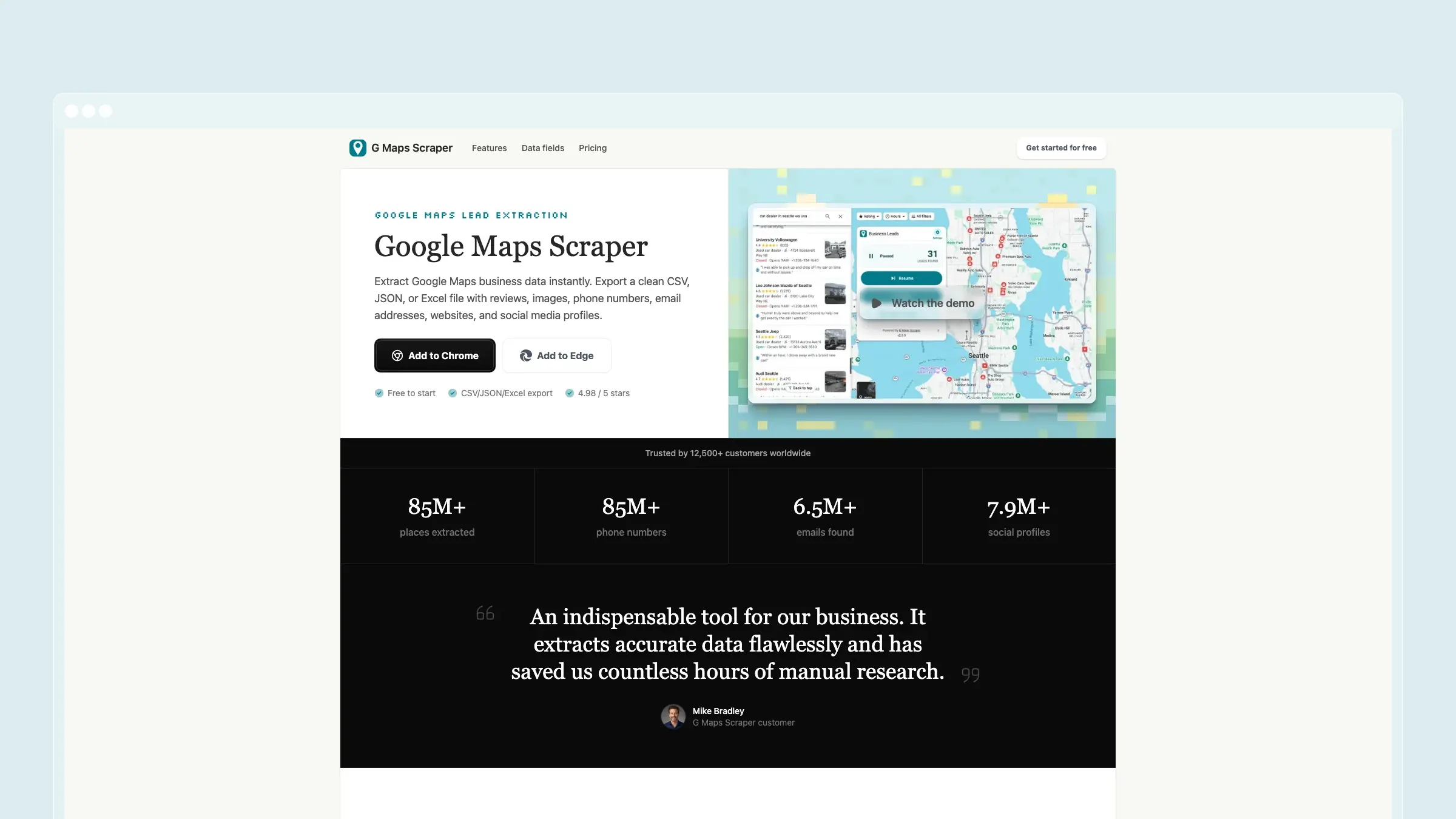
G Maps Scraper is built for one job: turning Google Maps searches into clean local lead lists. Search a category and location, run the extension, then export CSV, JSON, or Excel with names, categories, addresses, coordinates, phone numbers, websites, ratings, reviews, images, emails, and social profiles.
What G Maps Scraper does well:
- Fast no-code workflow from map search to export.
- Google Maps-first fields instead of generic scraped HTML.
- Email and social profile discovery for more useful outreach lists.
- Simple CSV, JSON, and Excel exports for spreadsheets and CRMs.
- Predictable free, Professional, and Business plans.
Where it is weaker than Scrap.io: G Maps Scraper focuses on Google Maps, while Scrap.io covers Google, Apple, and Bing Maps plus API and MCP workflows. If multi-map coverage is essential, Scrap.io is still compelling.
Pricing: Free plan with 1,000 leads per month. Professional is $39/month for 100,000 leads per month. Business is $99/month for larger extraction volume.
Best for: Sales teams, agencies, local marketers, recruiters, founders, and researchers who mainly need Google Maps business data.
The tradeoff: You trade a broad scraping platform for a focused lead extraction workflow. If Google Maps is the source, that is usually a good trade.
2. Outscraper
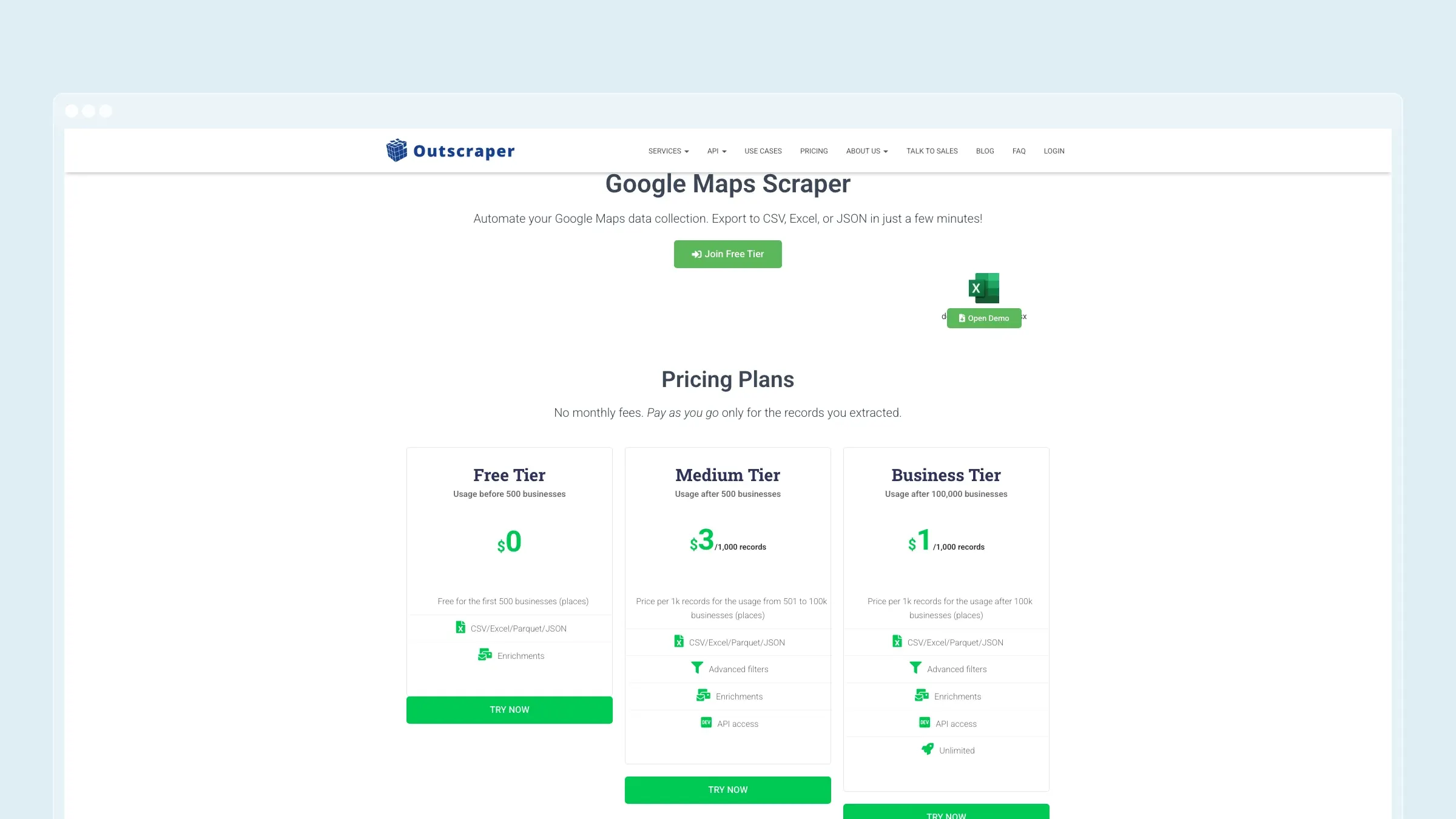
Outscraper is a managed Google Maps scraping product with dashboard runs, API access, real-time extraction, emails and contacts, and CSV, Excel, or JSON exports.
What Outscraper does well:
- Cloud execution for teams that do not want browser-based scraping.
- Dedicated Google Maps, reviews, photos, and place data workflows.
- API access for recurring internal pipelines.
- Pay-per-record pricing that can suit spiky usage.
- Contact enrichment options for business listings.
Where it is weaker than Scrap.io: Compared with Scrap.io, Outscraper has its own opinionated workflow and data model. Check whether its fields, export limits, API limits, and pricing shape match the way your team actually builds lead lists.
Pricing: The Google Maps Scraper page advertises the first 500 businesses free, then pay-per-record pricing such as $3 per 1,000 records at medium volume with lower rates at higher volume.
Best for: Teams that want cloud-based Google Maps extraction, recurring jobs, and API access without managing scraping infrastructure.
The tradeoff: Outscraper is easier than general scraping platforms for Maps, but less flexible for arbitrary websites.
3. DataForSEO
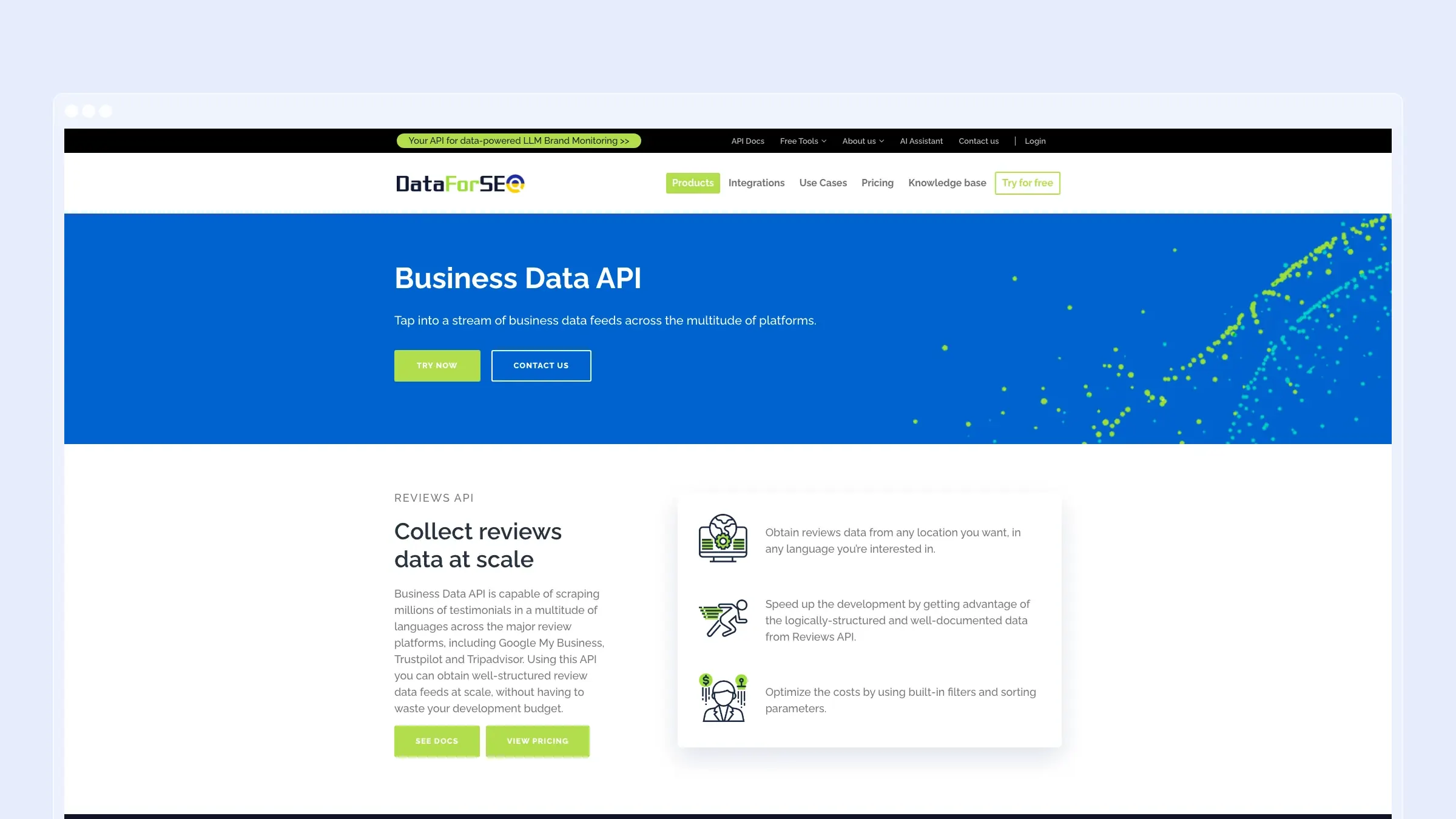
DataForSEO is an API vendor for SEO, SERP, keyword, backlinks, ecommerce, app, and business data. Its Business Data API includes Google Business profiles, Google Reviews, and other review sources.
What DataForSEO does well:
- Structured APIs with predictable request and response patterns.
- Useful for local SEO, rankings, reviews, and analytics workflows.
- Broad SEO API catalog beyond Google Maps.
- Clear usage-based pricing pages.
- Strong developer documentation and payload consistency.
Where it is weaker than Scrap.io: Compared with Scrap.io, DataForSEO has its own opinionated workflow and data model. Check whether its fields, export limits, API limits, and pricing shape match the way your team actually builds lead lists.
Pricing: DataForSEO uses pay-as-you-go pricing with a $50 minimum payment. Public pricing lists Google Business profile data from $0.0015 per profile for standard priority and $0.003 per profile for priority.
Best for: SEO software teams, agencies, data teams, and developers building local ranking, review, or analytics products.
The tradeoff: DataForSEO gives you APIs, not a finished prospecting app. Non-technical users will usually need a simpler interface.
4. Hunter
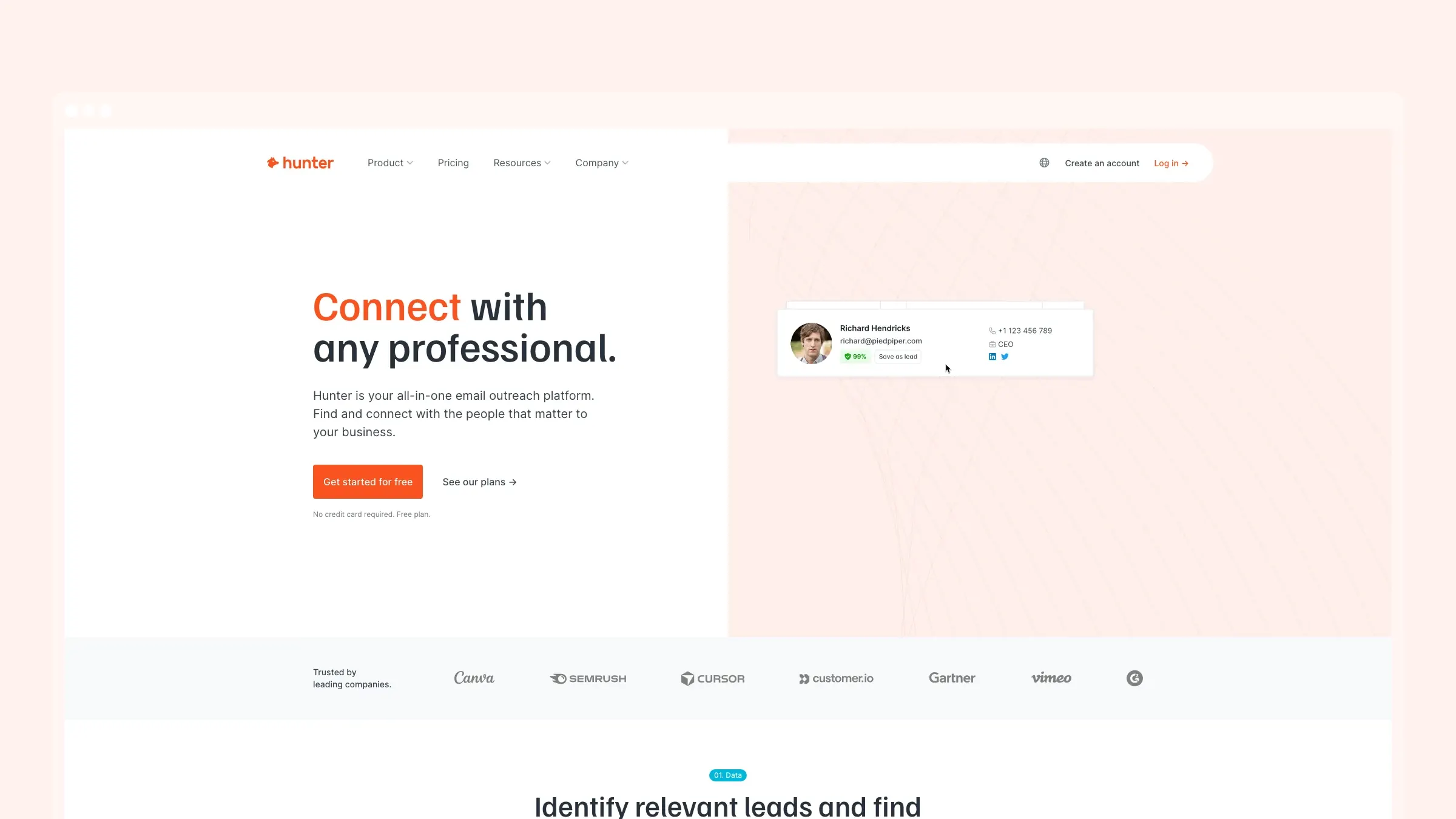
Hunter focuses on finding and verifying professional email addresses through domain search, email finder, verifier, campaigns, and API workflows.
What Hunter does well:
- Simple email discovery from domains and names.
- Email verification to reduce bounce risk.
- Campaign and API options for outbound teams.
- Useful enrichment layer for local business websites.
- Transparent credit-based pricing.
Where it is weaker than Scrap.io: Compared with Scrap.io, Hunter is less focused on finished Google Maps lead exports. It can be stronger for custom scraping, enrichment, or automation, but it may require more setup before you have a clean prospecting list.
Pricing: Hunter offers a free plan with 50 credits per month. Starter is $49/month, Growth is $149/month, Scale is $299/month, and Enterprise is custom.
Best for: Teams that already have business websites or domains and need verified emails for outreach.
The tradeoff: Hunter enriches contact data. It does not discover local businesses from Google Maps by itself.
5. Clay
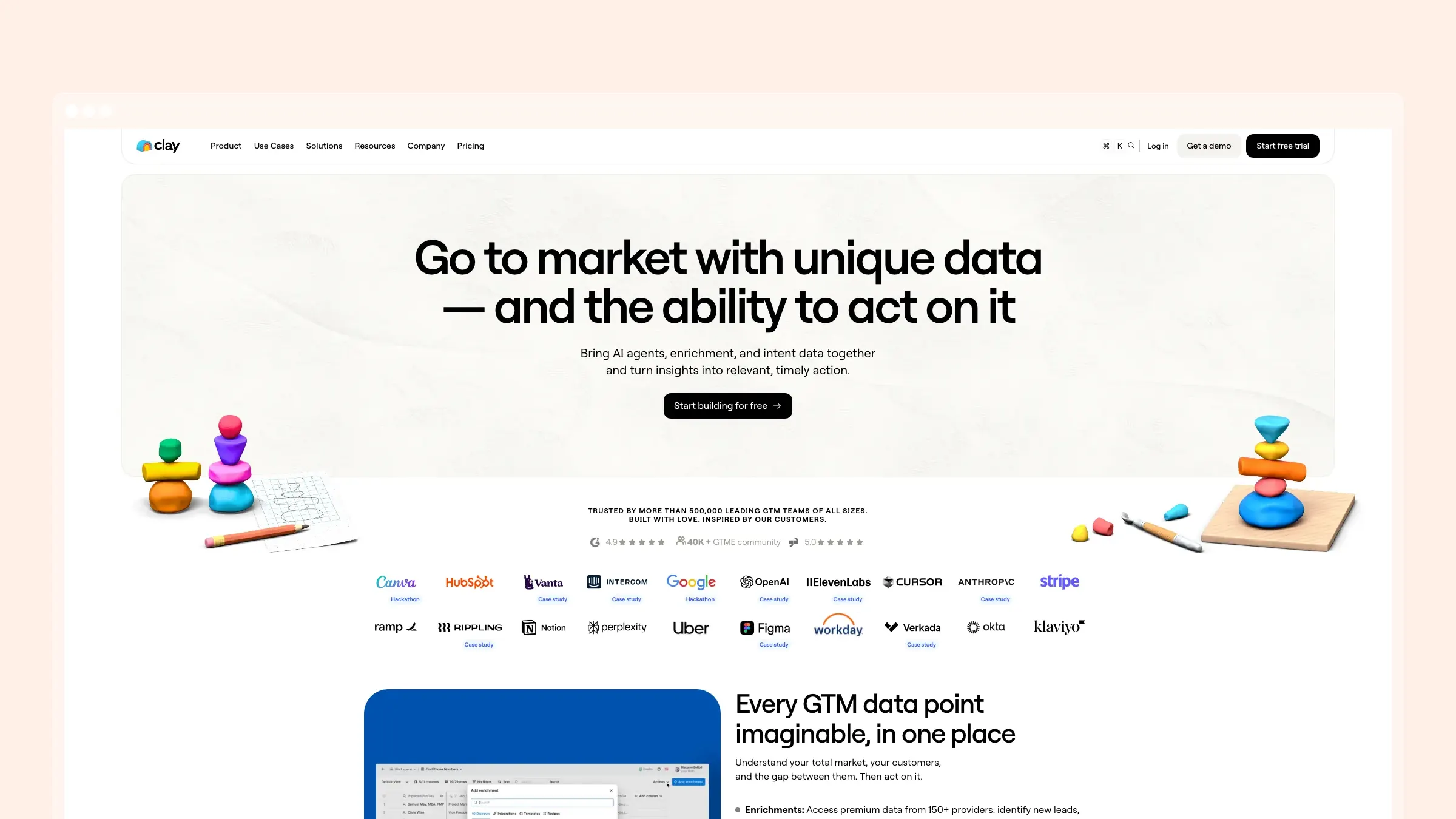
Clay is a GTM orchestration and enrichment workspace that combines data providers, AI research, waterfall enrichment, tables, sequencing, and integrations.
What Clay does well:
- Powerful enrichment workflows across many data providers.
- AI-assisted research and qualification.
- Waterfall enrichment can improve contact and company coverage.
- Flexible table-based workflow for GTM operations.
- Great for turning raw lists into qualified account data.
Where it is weaker than Scrap.io: Compared with Scrap.io, Clay is less focused on finished Google Maps lead exports. It can be stronger for custom scraping, enrichment, or automation, but it may require more setup before you have a clean prospecting list.
Pricing: Clay lists a free plan with 100 Data Credits and 500 Actions per month. Launch starts at $185/month, Growth starts at $495/month, and Enterprise is custom.
Best for: Growth, revenue operations, and sales teams that enrich and qualify accounts from multiple sources.
The tradeoff: Clay is best after you have a list. It is not the most direct way to scrape Google Maps from scratch.
6. PhantomBuster
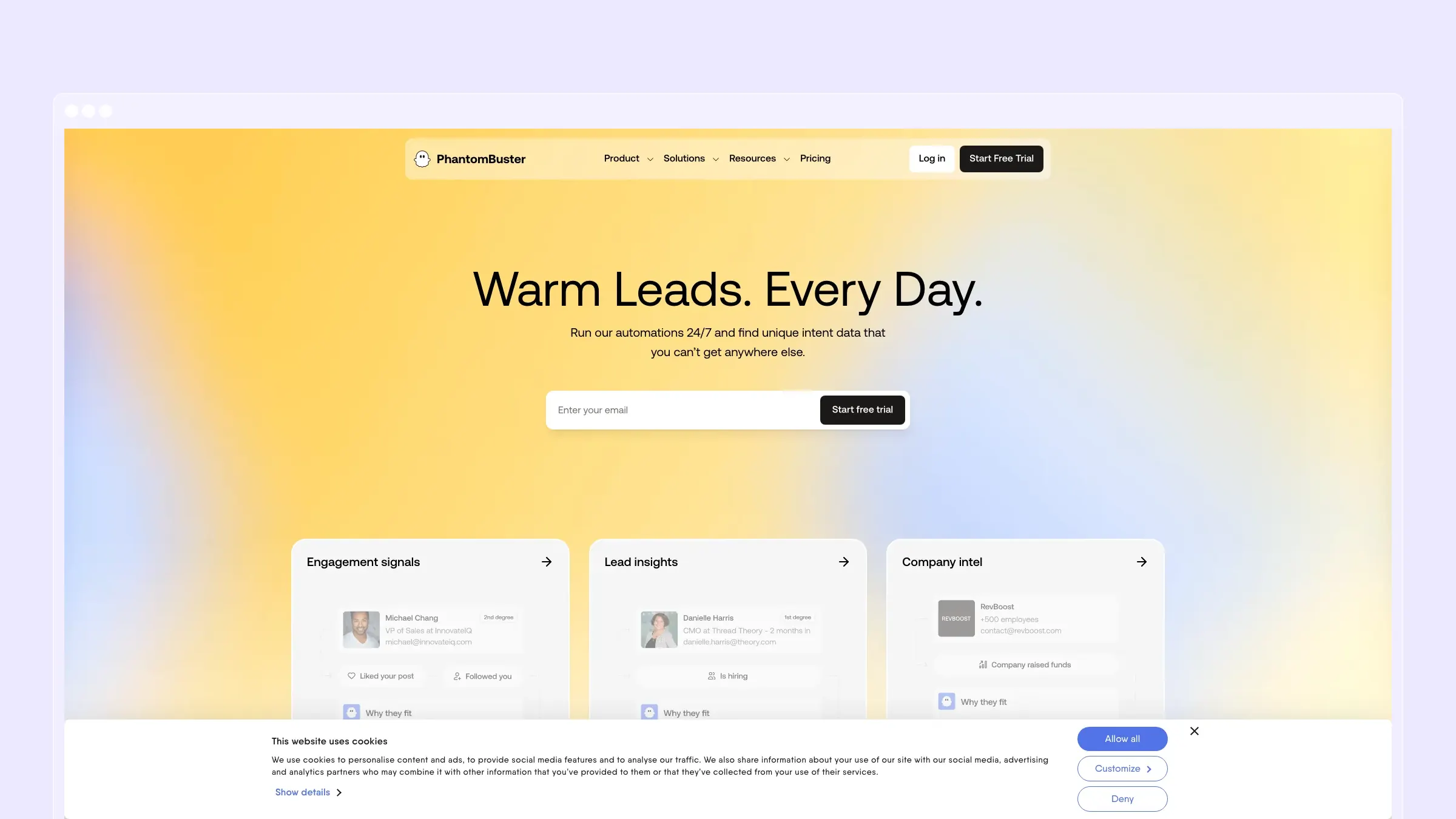
PhantomBuster is an automation platform for extracting and enriching lead data across channels such as LinkedIn, Google, social networks, and sales workflows.
What PhantomBuster does well:
- Large library of ready-made automation templates.
- Useful for lead sourcing and enrichment beyond Google Maps.
- Can chain automations into outbound workflows.
- Good fit for sales teams that already work across LinkedIn and web data.
- No need to build every workflow from scratch.
Where it is weaker than Scrap.io: Compared with Scrap.io, PhantomBuster is less focused on finished Google Maps lead exports. It can be stronger for custom scraping, enrichment, or automation, but it may require more setup before you have a clean prospecting list.
Pricing: PhantomBuster advertises a 14-day free trial and paid plans after the trial. Confirm current plan limits for execution time and workflow volume.
Best for: Growth teams and sales operators that want automated prospecting workflows across multiple channels.
The tradeoff: PhantomBuster is broader than map scraping, so Google Maps lead quality and exports may require more workflow design.
7. Google Places API
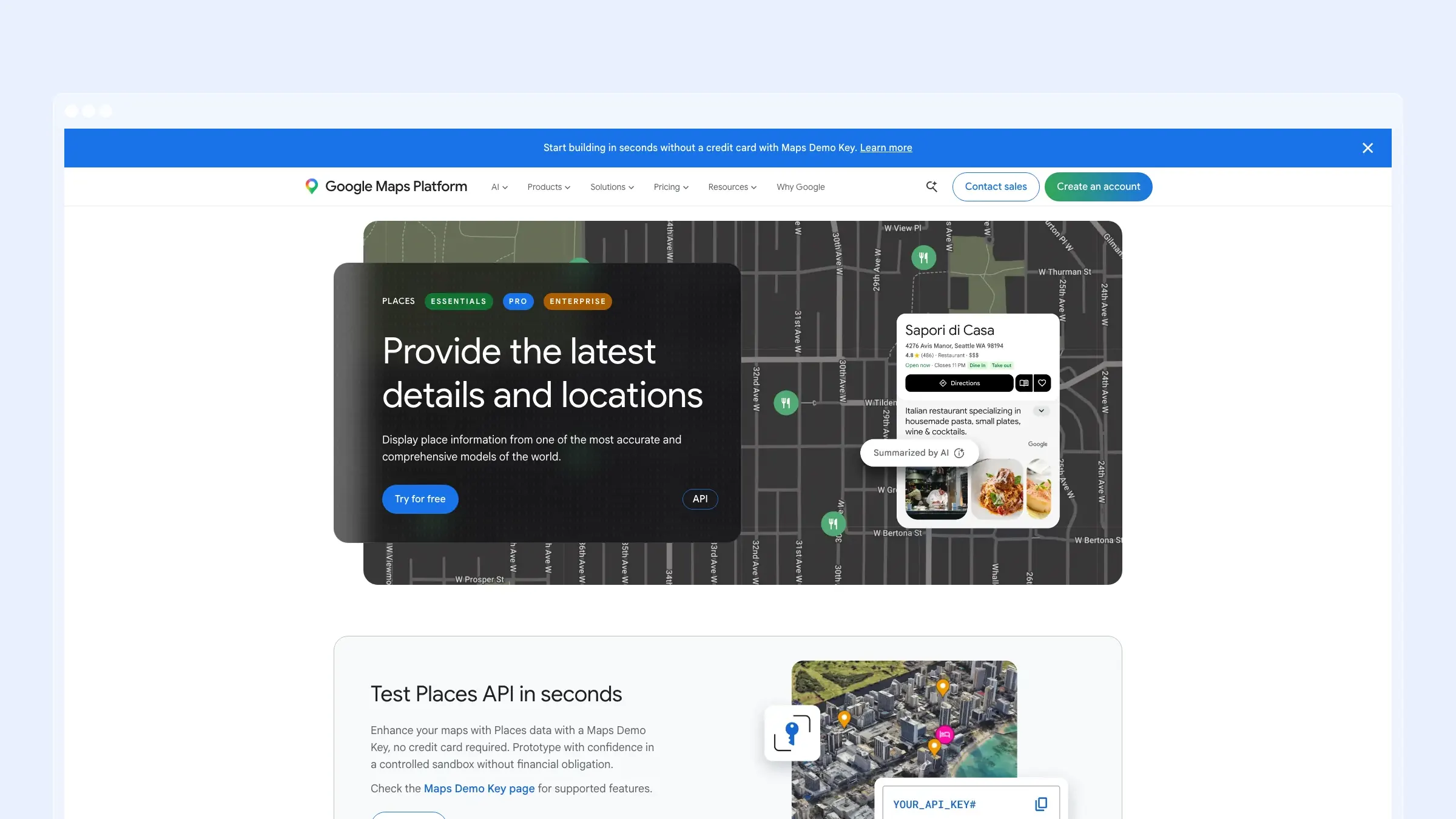
Google Places API is the official way to build applications on Google place data. It supports place search, place details, photos, and related Maps Platform workflows.
What Google Places API does well:
- Official Google API with documentation and platform support.
- Best fit for applications that need compliant place lookup.
- Place Details, Text Search, Nearby Search, and other endpoints.
- Predictable billing through Google Cloud.
- Works naturally inside apps already using Google Maps Platform.
Where it is weaker than Scrap.io: Compared with Scrap.io, Google Places API has its own opinionated workflow and data model. Check whether its fields, export limits, API limits, and pricing shape match the way your team actually builds lead lists.
Pricing: Pricing is usage based. Google lists monthly free caps on many Places API SKUs and charges per 1,000 requests after the free usage tier depending on endpoint and field set.
Best for: Product teams building apps, directories, maps, and internal tools that need official Google place data.
The tradeoff: It is not a scraping tool and it will not provide every field or enrichment a sales team expects from a lead scraper.
When You Should Stay With Scrap.io
Stay with Scrap.io if you value multi-map coverage, local lead filters, and API or MCP access more than a browser-based Google Maps workflow.
No alternatives list should pretend that the seed product is never the right choice. Scrap.io may still be the best fit if its current workflow, pricing model, integrations, and data coverage already match your team.
Which Scrap.io Alternative Should You Choose?
Choose G Maps Scraper if you mainly need Google Maps business data and want the fastest path to CSV, JSON, or Excel.
Choose Outscraper if you want managed cloud Google Maps scraping and API access without browser extension workflows.
Choose DataForSEO if you are building a local SEO, review monitoring, or analytics product with structured APIs.
Choose Hunter if you already have domains and need verified email addresses.
Choose Clay if you need enrichment, AI research, and GTM orchestration after list building.
Choose PhantomBuster if you want lead sourcing automations that span LinkedIn, Google, social, and outbound workflows.
Choose Google Places API if you need official Google place data inside an application.
Bottom Line
For direct Google Maps exports, choose G Maps Scraper. For cloud scraping, use Outscraper. For structured local SEO, reviews, and business data APIs, compare DataForSEO. For email discovery after extraction, Hunter is stronger. For enrichment, Clay is the power tool. For automation, PhantomBuster is useful, and for official place data, Google Places API is the stable option.
If your main requirement is simple Google Maps lead extraction with business names, phone numbers, websites, emails, reviews, ratings, images, social profiles, and clean exports, G Maps Scraper is the best place to start. It is narrower than many tools on this list, and that is exactly why it is easier to use for local prospecting.


