


Octoparse is broad and visual. That is its strength. It is useful when non-technical users need to scrape many kinds of websites. But broad visual scraping can still feel like too much setup when the actual job is recurring Google Maps lead extraction.
This guide compares seven popular Octoparse alternatives for Google Maps scraping, local lead generation, and adjacent data workflows. G Maps Scraper is ranked first because it is the most direct option when the core job is extracting businesses from Google Maps into a usable file.
Some alternatives are focused local lead tools. Some are APIs. Some are broader scraping or sales automation platforms. The right choice depends on whether you want a finished spreadsheet, a developer API, a broader enrichment workflow, or enterprise-grade infrastructure.
Quick Comparison
| Tool | Best For | Starting Price | Workflow | Google Maps Focus | Best Octoparse Replacement Case |
|---|---|---|---|---|---|
| G Maps Scraper | No-code Google Maps lead extraction | Free / $39/mo | Chrome and Edge extension | Dedicated | Fast exports with phones, websites, emails, reviews, and social profiles |
| ParseHub | Visual scraping for complex websites | Free plan / paid plans | Desktop app and cloud runs | Adjacent | Visual scraping projects for complex websites |
| Web Scraper | Browser extension scraping | Free extension / cloud from $50/mo | Extension and cloud | Adjacent | Free extension-based selector scraping |
| Apify | Marketplace of hosted web scrapers | Free / $29/mo plus usage | Actor marketplace and platform | Actor based | Actor marketplace and hosted scraping platform |
| Bardeen | AI-assisted sales and web automation | 100 free credits / $10/mo | Agents and automations | Adjacent | AI-assisted GTM automation and enrichment workflows |
| ScraperAPI | Simple proxy-backed scraping API | 1,000 free credits / paid plans | API | Adjacent | Simple proxy-backed API for custom crawlers |
| ScrapingBee | General web scraping API | 1,000 free credits / $49/mo | API | Not dedicated | Developer API for rendering, proxies, and custom extraction |
How We Chose These Octoparse Alternatives
This list mixes focused Google Maps tools, visual scraper builders, browser scrapers, sales automation tools, scraping platforms, and developer APIs so you can choose by workflow rather than brand familiarity.
The criteria were:
- Clear relevance to Google Maps scraping, local business data, lead generation, or the next step after a lead list.
- Enough market visibility to be worth evaluating.
- Public product pages, docs, or pricing pages that make the workflow understandable.
- A real reason to choose the product over Octoparse: simpler exports, better Google Maps focus, API-first access, broader automation, stronger enrichment, or enterprise infrastructure.
1. G Maps Scraper
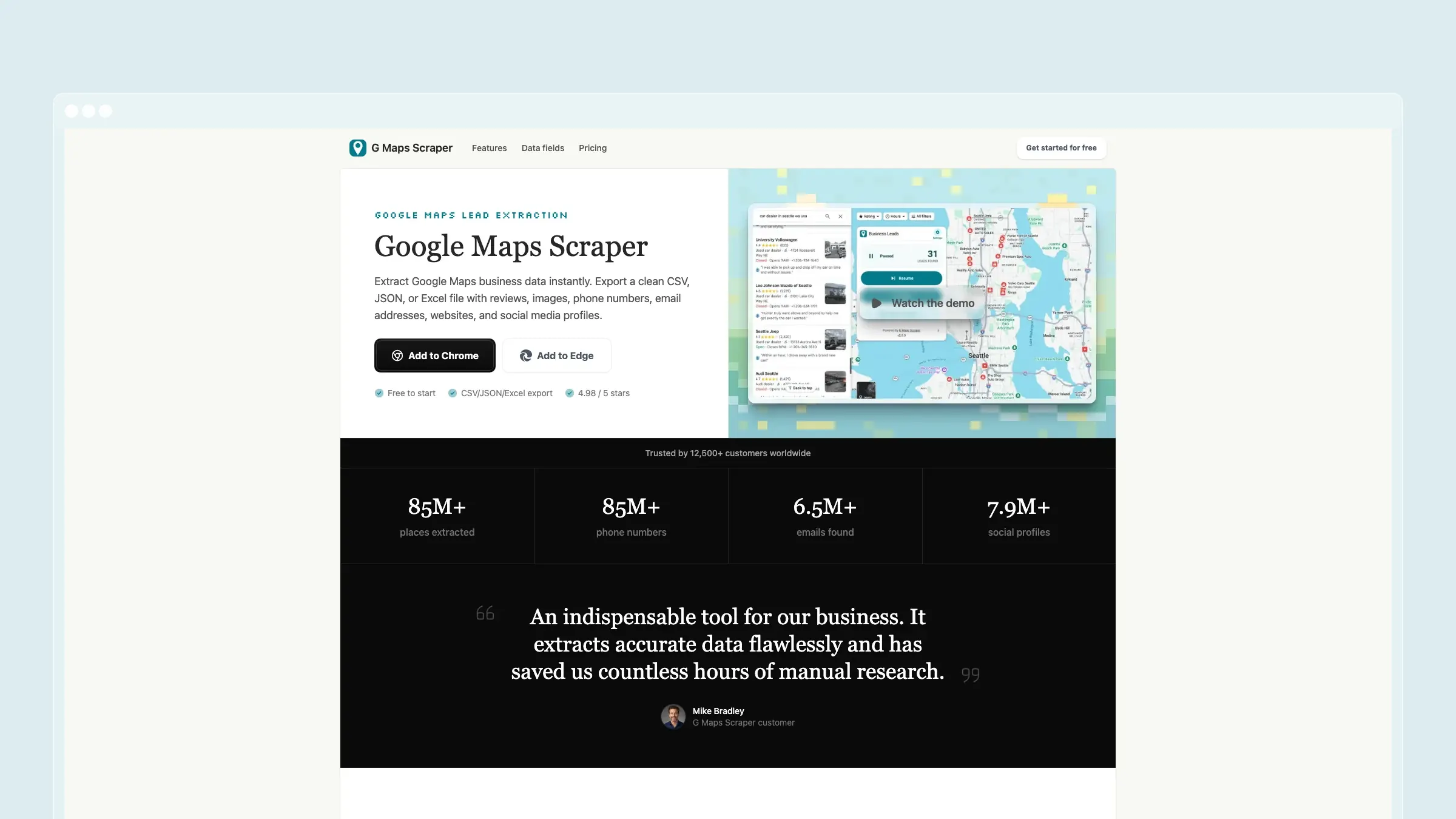
G Maps Scraper is built for one job: turning Google Maps searches into clean local lead lists. Search a category and location, run the extension, then export CSV, JSON, or Excel with names, categories, addresses, coordinates, phone numbers, websites, ratings, reviews, images, emails, and social profiles.
What G Maps Scraper does well:
- Fast no-code workflow from map search to export.
- Google Maps-first fields instead of generic scraped HTML.
- Email and social profile discovery for more useful outreach lists.
- Simple CSV, JSON, and Excel exports for spreadsheets and CRMs.
- Predictable free, Professional, and Business plans.
Where it is weaker than Octoparse: G Maps Scraper is not a visual scraper for arbitrary websites. If your work spans ecommerce pages, directories, job boards, and custom web apps, Octoparse may remain more flexible.
Pricing: Free plan with 1,000 leads per month. Professional is $39/month for 100,000 leads per month. Business is $99/month for larger extraction volume.
Best for: Sales teams, agencies, local marketers, recruiters, founders, and researchers who mainly need Google Maps business data.
The tradeoff: You trade a broad scraping platform for a focused lead extraction workflow. If Google Maps is the source, that is usually a good trade.
2. ParseHub
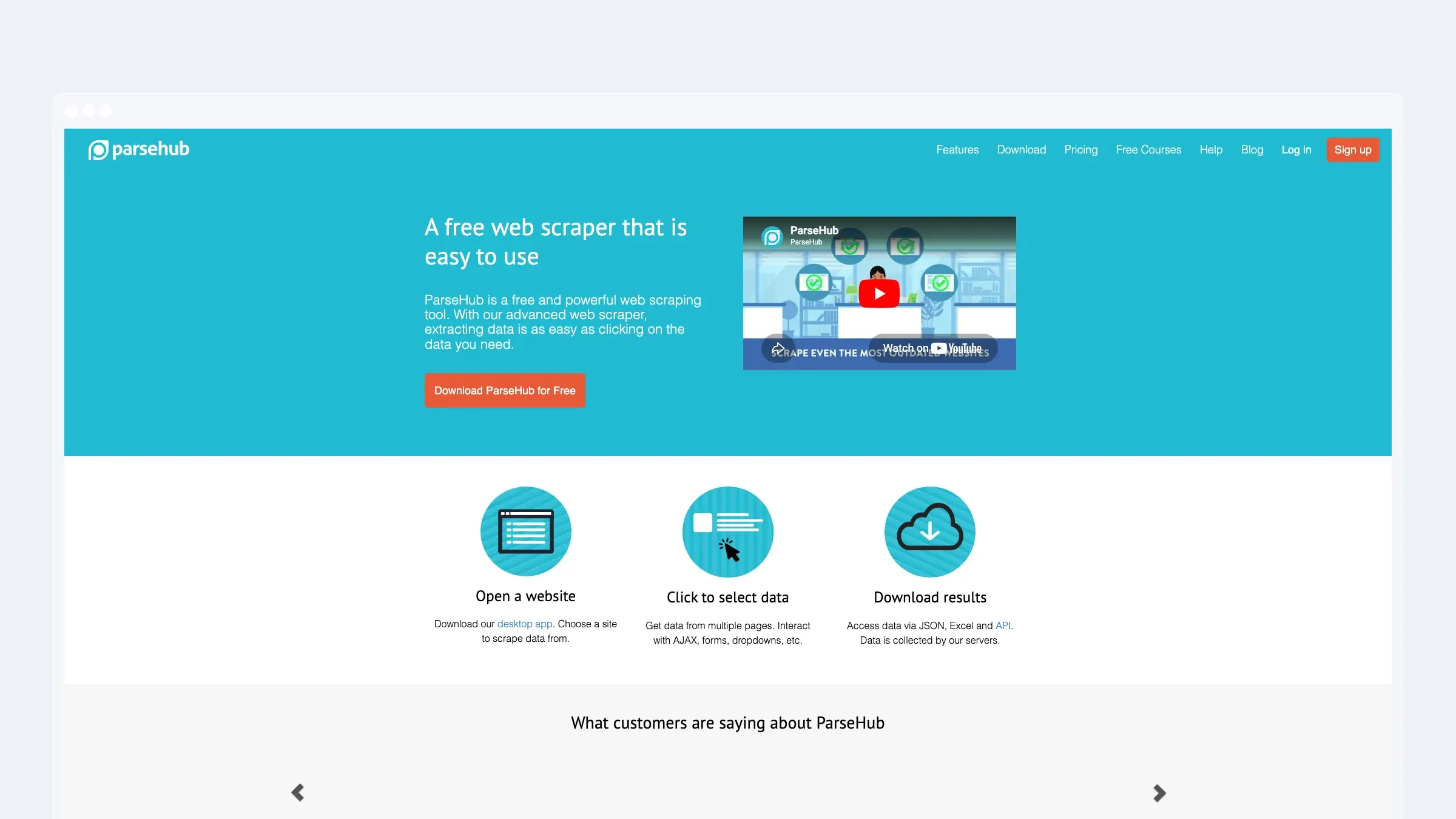
ParseHub is a visual web scraping tool for turning dynamic websites into structured data. It is often evaluated by teams that want a point-and-click scraper with cloud execution and exports.
What ParseHub does well:
- Visual project builder for complex pages.
- Works on many dynamic websites beyond Google Maps.
- Free plan for testing smaller projects.
- Cloud execution and scheduling on paid plans.
- Useful for analysts who do not want to maintain code.
Where it is weaker than Octoparse: Compared with Octoparse, ParseHub is less focused on finished Google Maps lead exports. It can be stronger for custom scraping, enrichment, or automation, but it may require more setup before you have a clean prospecting list.
Pricing: ParseHub offers a free plan and paid plans for higher page volume, faster runs, scheduling, and team or enterprise needs. Confirm current limits on the pricing page before buying.
Best for: Analysts and operations teams that need a visual scraper for dynamic sites and can spend time configuring projects.
The tradeoff: ParseHub is flexible, but Google Maps lead generation usually needs more setup and cleanup than a dedicated map scraper.
3. Web Scraper
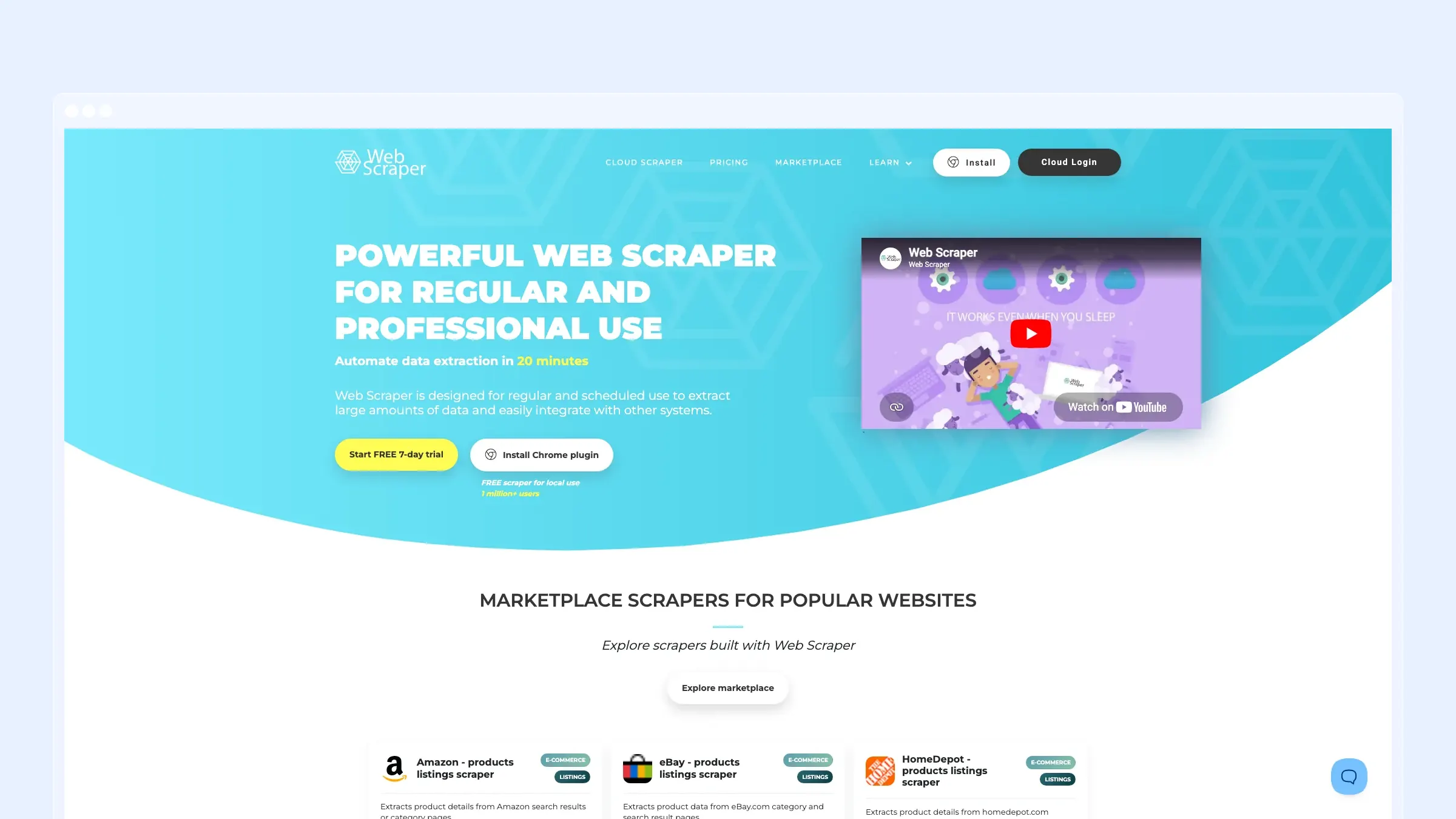
Web Scraper is a popular point-and-click scraping extension for Chrome and Firefox with optional cloud scraping, scheduling, API access, and proxy support.
What Web Scraper does well:
- Free browser extension for local scraping.
- Point-and-click sitemap builder.
- CSV, XLSX, and JSON exports.
- Optional cloud scheduler and API.
- Useful for learning and lightweight extraction tasks.
Where it is weaker than Octoparse: Compared with Octoparse, Web Scraper is less focused on finished Google Maps lead exports. It can be stronger for custom scraping, enrichment, or automation, but it may require more setup before you have a clean prospecting list.
Pricing: The browser extension is free. Web Scraper Cloud pricing starts at $50/month for Project, with higher Professional, Scale, and Enterprise plans.
Best for: Users who want a low-cost browser-based scraper and are comfortable configuring selectors.
The tradeoff: It is flexible but manual. Google Maps lead generation may require more setup and cleaning than a dedicated tool.
4. Apify
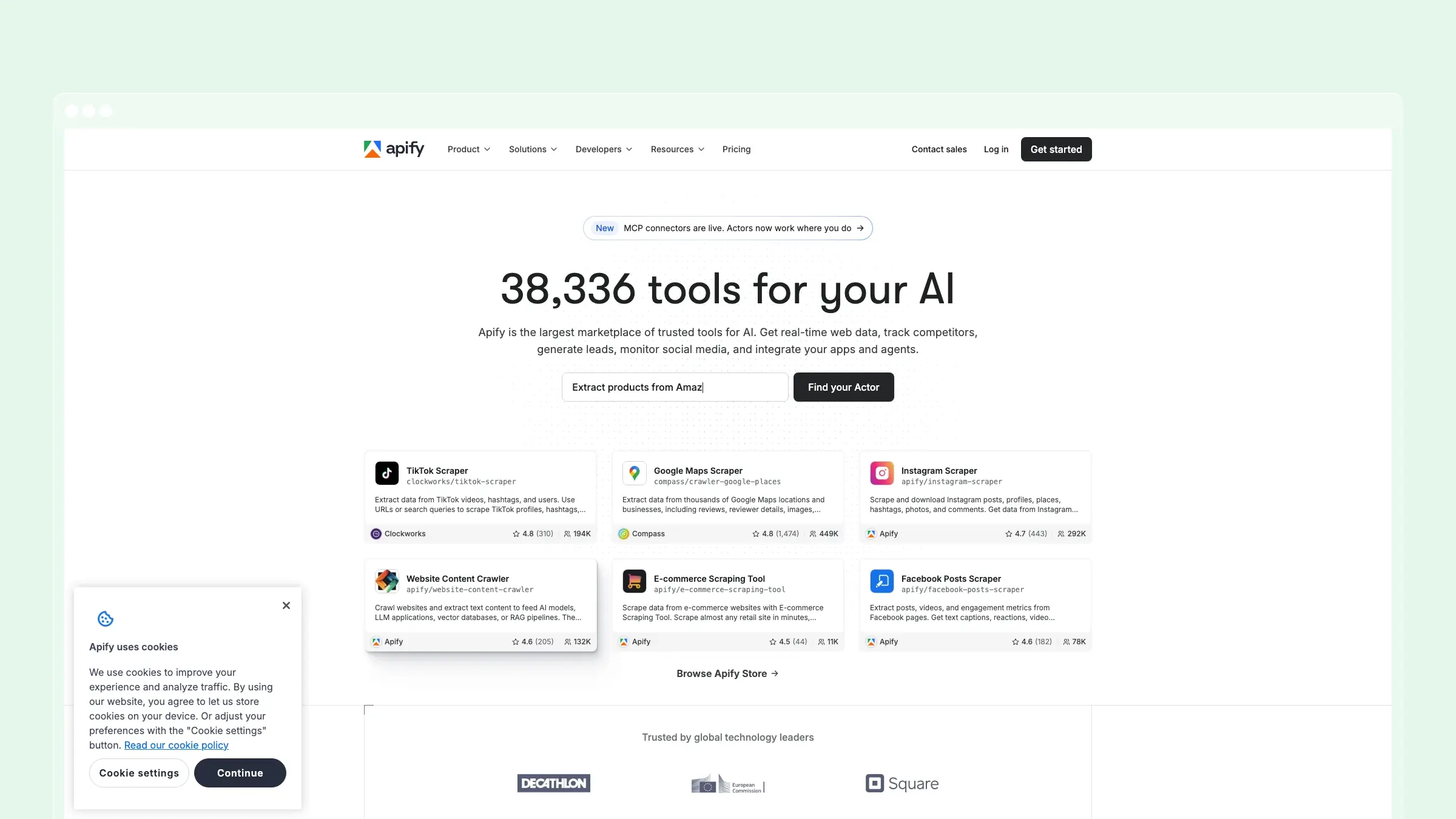
Apify is a full web scraping and automation platform with a large Actor marketplace, serverless runs, proxies, datasets, storage, APIs, and webhooks.
What Apify does well:
- Huge marketplace of ready-made Actors.
- Supports custom scraping logic in hosted runs.
- Scheduling, datasets, storage, and webhooks in one platform.
- Good fit for many unrelated scraping targets.
- Developers can build and monetize their own Actors.
Where it is weaker than Octoparse: Compared with Octoparse, Apify is less focused on finished Google Maps lead exports. It can be stronger for custom scraping, enrichment, or automation, but it may require more setup before you have a clean prospecting list.
Pricing: Apify has a free plan and a $29/month Starter plan plus pay-as-you-go usage. Real cost depends on Actors, compute units, proxies, storage, and data transfer.
Best for: Developers and data teams that need one flexible platform for many scraping and automation jobs.
The tradeoff: Apify is powerful, but it can be more platform than a simple Google Maps lead workflow needs.
5. Bardeen
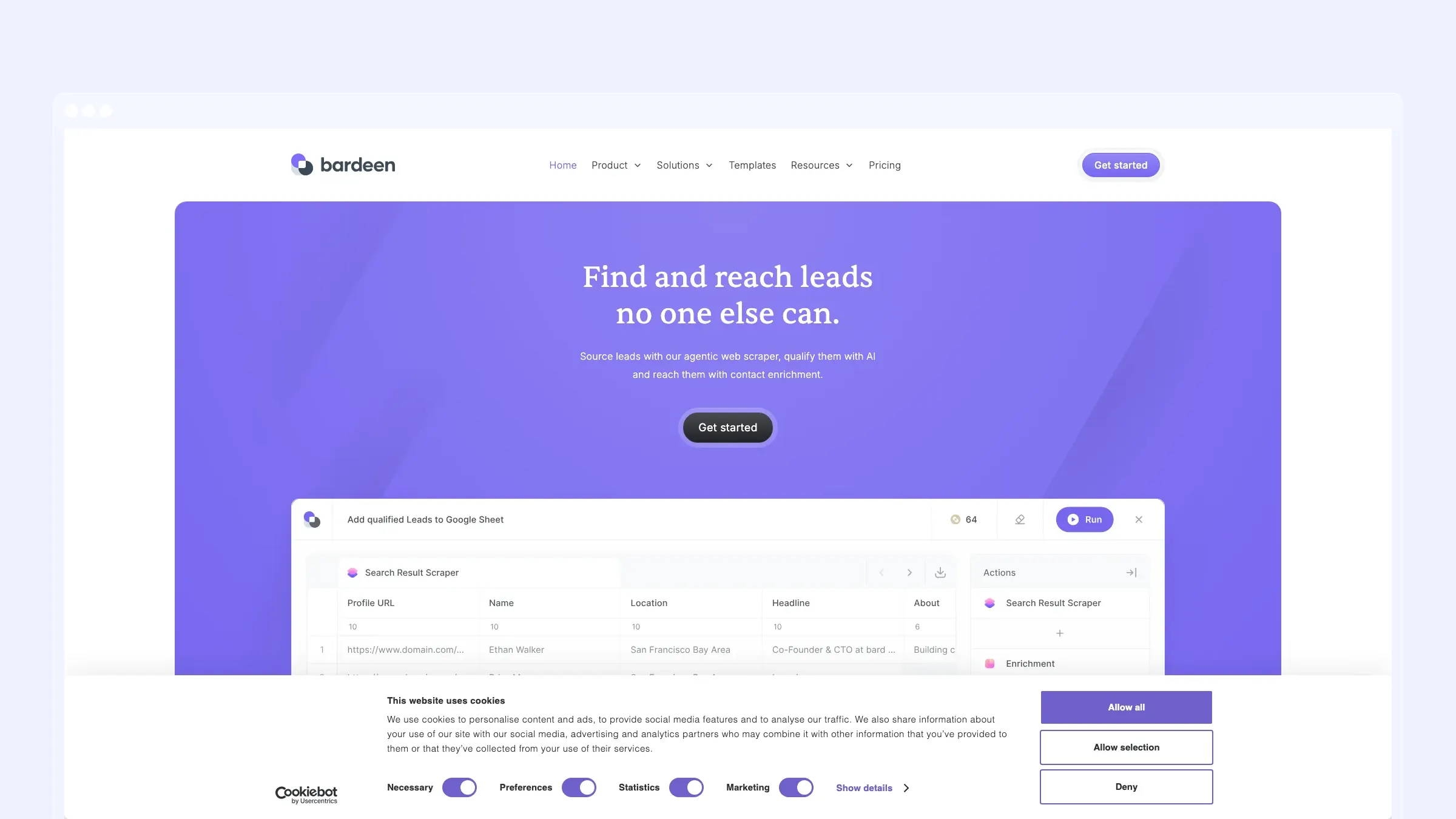
Bardeen is an AI automation platform for GTM work, web scraping, search, enrichment, and spreadsheet integrations. It is built around agents and reusable automations.
What Bardeen does well:
- AI-assisted workflows for lead sourcing and enrichment.
- Scraping, search, validation, and export actions in one flow.
- Good spreadsheet and workflow integrations.
- Useful for teams that automate many small GTM tasks.
- Lower starting price than many scraping suites.
Where it is weaker than Octoparse: Compared with Octoparse, Bardeen is less focused on finished Google Maps lead exports. It can be stronger for custom scraping, enrichment, or automation, but it may require more setup before you have a clean prospecting list.
Pricing: Bardeen lists 100 free credits, Basic from $10/month, and Premium from $50/month, with credits used by scraping, enrichment, and AI actions.
Best for: Sales and ops teams that want automation around prospecting, enrichment, and exports.
The tradeoff: Bardeen is a workflow tool. Dedicated Google Maps scraping depth depends on the automations you build.
6. ScraperAPI
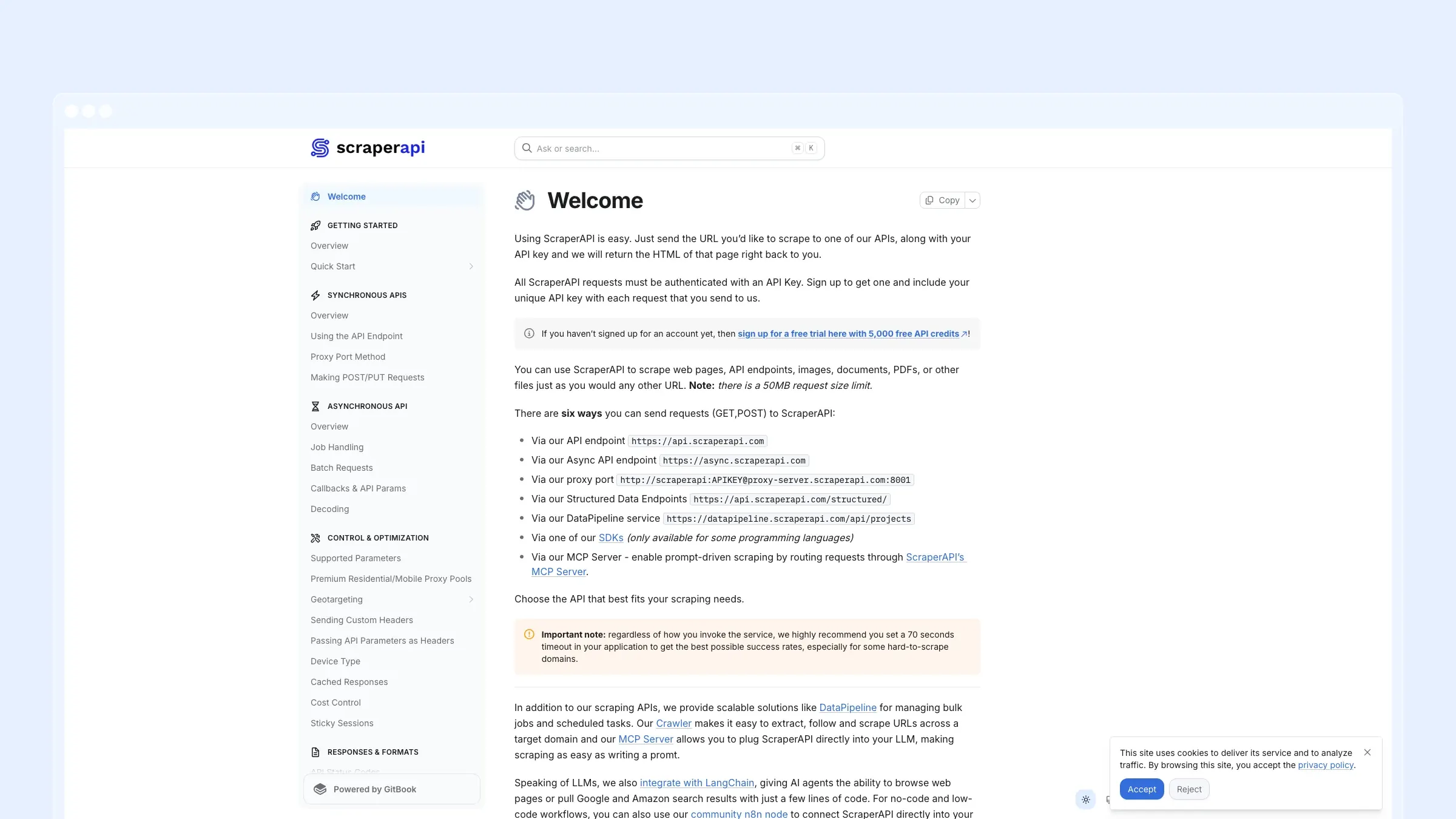
ScraperAPI is a scraping API that handles proxies, browsers, CAPTCHA, and request retries so developers can collect data from public websites through a single endpoint.
What ScraperAPI does well:
- Simple API setup for developers.
- Proxy and browser handling abstracted away.
- Good for teams that already write custom crawlers.
- Free credits for testing.
- Scales from small scripts to larger scraping programs.
Where it is weaker than Octoparse: Compared with Octoparse, ScraperAPI is less focused on finished Google Maps lead exports. It can be stronger for custom scraping, enrichment, or automation, but it may require more setup before you have a clean prospecting list.
Pricing: ScraperAPI advertises 1,000 free API credits and paid plans that scale by credits and features.
Best for: Developers who need scraping access infrastructure while keeping extraction code in their own system.
The tradeoff: ScraperAPI is not a no-code Google Maps exporter. It is a lower-level building block.
7. ScrapingBee
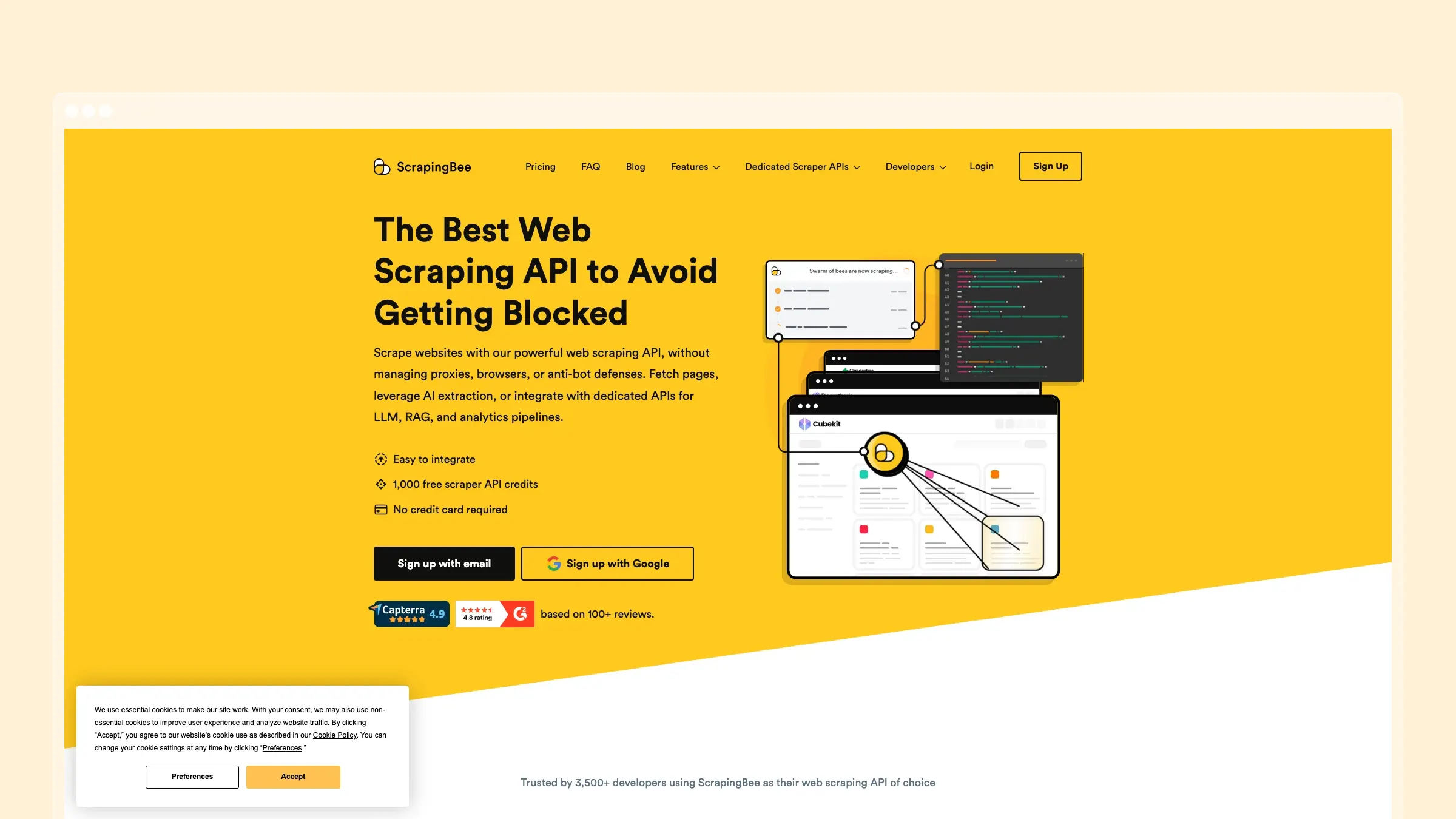
ScrapingBee is a web scraping API for developers. It handles JavaScript rendering, headless Chrome, proxy rotation, screenshots, geotargeting, and anti-bot work behind a simple API call.
What ScrapingBee does well:
- Simple API for fetching rendered pages reliably.
- JavaScript rendering and headless browser support.
- Proxy rotation, geotargeting, and screenshots.
- Credit-based pricing that is easy to estimate.
- Good fit for custom scraping code and monitoring workflows.
Where it is weaker than Octoparse: Compared with Octoparse, ScrapingBee is less focused on finished Google Maps lead exports. It can be stronger for custom scraping, enrichment, or automation, but it may require more setup before you have a clean prospecting list.
Pricing: ScrapingBee offers 1,000 free credits. Paid plans start at $49/month for the Freelance plan and scale by credit volume and features.
Best for: Developers who need scraping infrastructure without managing browsers, proxies, and anti-bot handling themselves.
The tradeoff: ScrapingBee gives developers infrastructure, but it does not turn Google Maps into a lead list without custom extraction logic.
When You Should Stay With Octoparse
Stay with Octoparse if you want one no-code scraper for many website types and your team is comfortable building and maintaining scraping tasks.
No alternatives list should pretend that the seed product is never the right choice. Octoparse may still be the best fit if its current workflow, pricing model, integrations, and data coverage already match your team.
Which Octoparse Alternative Should You Choose?
Choose G Maps Scraper if you mainly need Google Maps business data and want the fastest path to CSV, JSON, or Excel.
Choose ParseHub if you want a visual scraper for dynamic websites and are comfortable configuring projects.
Choose Web Scraper if you want a low-cost browser extension and can configure selectors manually.
Choose Apify if you need an Actor marketplace and hosted automation for many websites.
Choose Bardeen if your GTM team wants AI-assisted scraping, enrichment, and spreadsheet automations.
Choose ScraperAPI if you already write extraction code and need proxy-backed request infrastructure.
Choose ScrapingBee if developers need rendering, proxies, screenshots, and raw page access behind an API.
Bottom Line
For Google Maps lead extraction, choose G Maps Scraper. For visual scraping, compare ParseHub and Web Scraper. For automation breadth, Bardeen and Apify are better fits. For developer APIs, ScraperAPI and ScrapingBee belong on the shortlist.
If your main requirement is simple Google Maps lead extraction with business names, phone numbers, websites, emails, reviews, ratings, images, social profiles, and clean exports, G Maps Scraper is the best place to start. It is narrower than many tools on this list, and that is exactly why it is easier to use for local prospecting.


